
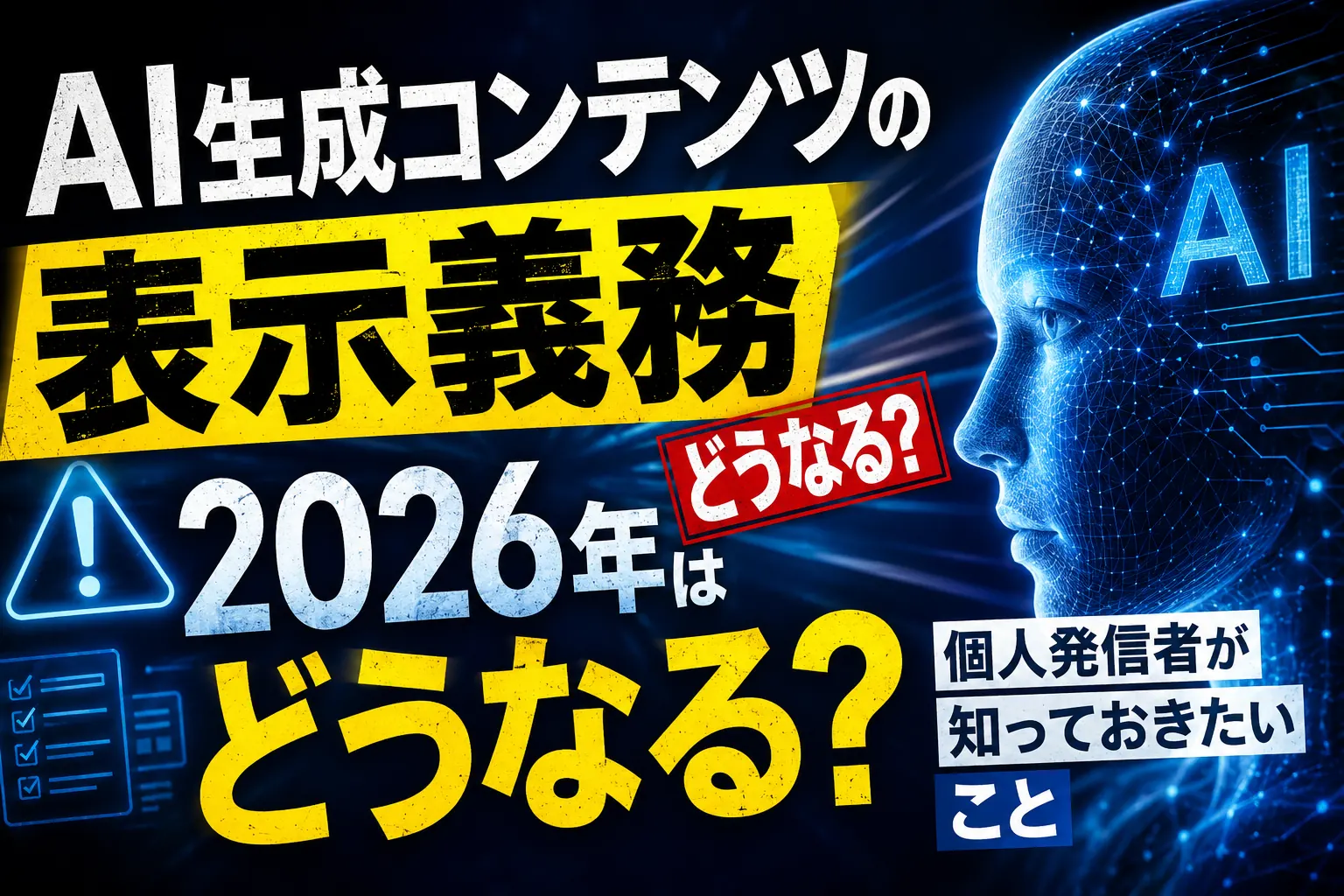
AI-Generated Content Labeling Requirements: What Happens in 2026? What Individual Creators Should Know
This article was translated from Japanese and was originally written for readers in Japan.
"From now on, do I have to write 'this was made by AI' on posts I wrote with AI?" More and more people have that question. 2026 was the year when rules on the labeling and disclosure of AI-generated content moved worldwide. In this article we'll sort through the trends individual creators should know at a minimum, and how to balance efficiency with trust. We'll keep the difficult legal talk to the key points, so read on without bracing yourself.
In 2026, AI Labeling Requirements Are "Advancing" Worldwide#
To state the conclusion first, the move toward disclosing that something is AI-generated isn't stopping; it's getting stronger. Here's a rough list of the main developments.
- EU AI Act: Transparency obligations for limited-risk AI are said to begin applying in August 2026, and work is also progressing on a code of practice on the transparency of AI-generated content
- China: Under rules that took effect in September 2025, the direction is to require both a "visible label" and an "invisible digital watermark" on AI-generated material
- South Korea: It is said to be aiming for early-2026 enforcement of a revision that requires labels on ads created or edited with AI and also makes platforms responsible for compliance
- Japan: AI-related legislation came fully into force in 2025, and the country is at a stage where stronger governance is called for on the premise of voluntary efforts by companies
The degree of enforcement differs from country to country, but the direction of "making it clear that it's AI" is shared.
Social Platforms' Rules Have Also Shifted Toward Assuming Disclosure#
Policies on the platform side are moving as well. We'll narrow it down to the points likely to matter to individual creators.
- TikTok: It is said to require creators themselves to label AI-generated content depicting real people, places, or events, and to handle unlabeled content through automatic detection
- X (formerly Twitter): In its March 2026 policy revision, a financial penalty is under consideration: suspension of revenue sharing for a set period if disclosure is neglected on AI-generated videos related to certain significant events
- Meta (Instagram / Facebook): The direction is to require identifying labels and digital watermarks on AI-generated material
In fact, what matters here is "whether it could be mistaken for reality". The more something passes itself off as a real person or event, the stricter the treatment; for uses of AI like explaining what your product stands for or cleaning up text, there are many situations where you don't need to be overly nervous.
How Individuals Can Balance Efficiency and Trust#
There's no need to fear the rules and stop posting. Using AI is not bad in itself; the problem is "misleading people". That's the thinking shared across countries.
- Don't pass things off as fact: Don't present events that didn't happen or statements by people who don't exist as if they were real. Keep to this alone and you're on the safe side in most cases
- Be especially careful with images and video: Compared with text, AI-generated photos and videos carry a higher risk of misleading people. Assume disclosure for realistic depictions of people
- An attitude of not hiding that "I'm using AI": Disclosure isn't damage to trust; if anything, it's becoming a way of showing your honesty
You don't need to force yourself to memorize every rule. Holding on to just one principle, "don't deceive the people who read you," is enough.
Summary#
For 2026, the key points were these three: (1) AI disclosure is getting stronger worldwide, (2) social platforms are also shifting toward assuming disclosure, and (3) the key is "not letting it be mistaken for reality". Using AI to clean up text or to shape your brand voice is not, in itself, something to fear excessively.
What matters is balancing efficiency with honesty. Lean on AI while not deceiving the people who read you. As long as you hold that line, you can keep posting without being pushed around too much by changes in the rules.
There's no need to feel guilty about using AI in itself. Toukoukun is a tool where AI writes posts tailored to X / Instagram / Threads / Facebook based on what your work stands for. It's built on the idea of reducing the effort of getting your message across, not of bending the facts. If you're curious, you can try it from the dashboard.