mixi Started in 2004: The Invitation-Only Era That Shaped the Dawn of Social Media in Japan
This article was translated from Japanese and was originally written for readers in Japan.
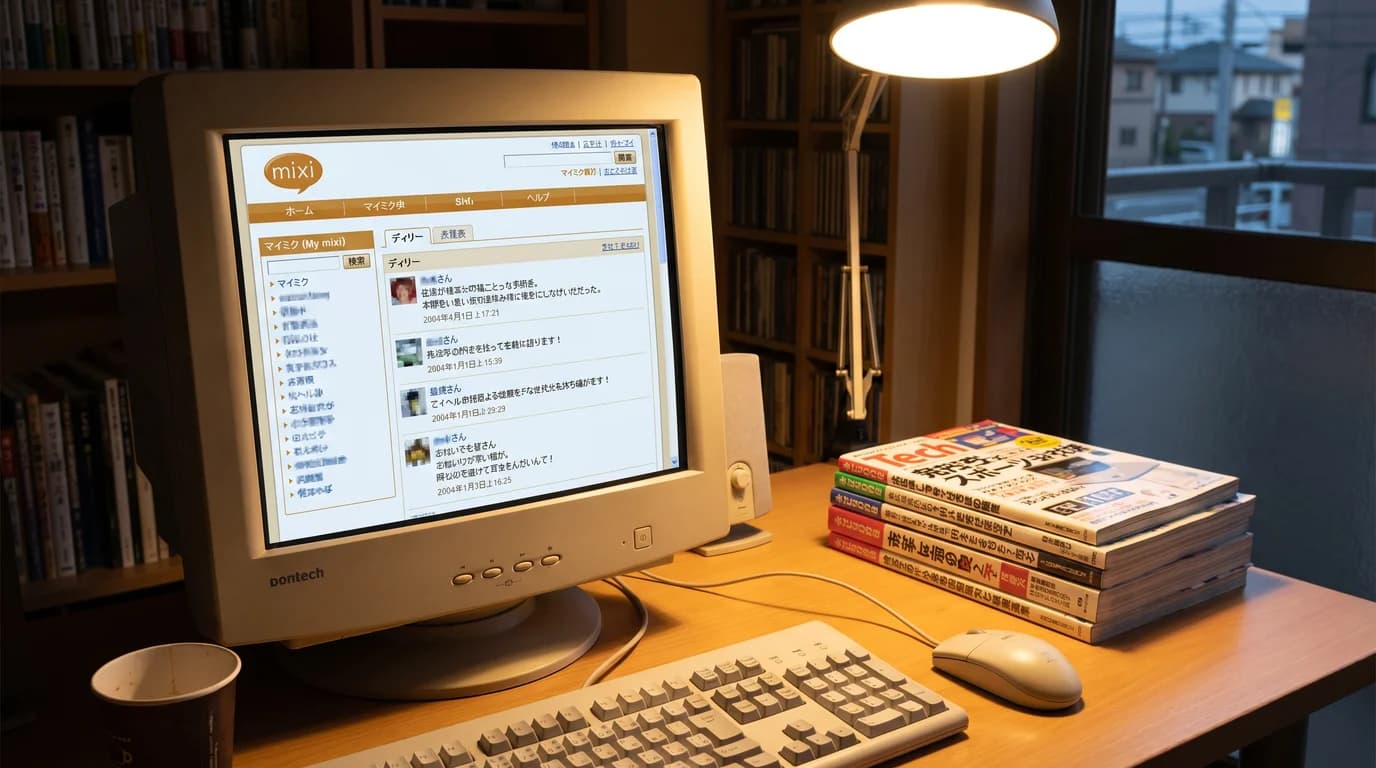
2004. mixi, a service you cannot leave out when talking about the history of social media in Japan, came into the world. Its founder is Kenji Kasahara. Unusually for the time, its “invitation-only” system, where you could not join without an invitation from a friend who was already registered, created a distinctive sense of safety and connection. Diaries, "footprints" (a log of who visited your page), communities — the prototypes of much of today's social media culture were made in this era. In this article, we look back at the dawn of social media in Japan and consider the lessons that era's culture left for posting today.
The sense of safety in "you can't get in without an invitation"#
mixi's defining feature was that not just anyone could sign up freely; you needed an invitation from an existing user. It is the exact opposite of the design of today's open social networks, but for its time it worked exquisitely.
- An atmosphere close to real names: Because people connected through invitations, real-life acquaintances formed the base, and the mood was one where things rarely turned hostile
- The "footprints" culture: A feature that showed who had visited your page created a gentle mutual awareness
- The community feature: The mechanism for people to gather by hobby or region was a forerunner of later group features and hashtag culture
Connecting within the range of not some stranger, but as far as friends of friends. This sense of distance lowered the bar for posting. It was not a place to aim for virality but a place to write about daily events in a diary, and that is the big difference from today.
An era when the bar for "writing" was low#
Here is the main point. In the mixi era, writing a diary entry had almost nothing to do with virality or numbers. Only people you knew read it. So you could write about what you ate today or some small realization without bracing yourself. In fact, this very "casualness" is what social media posting today tends to lose.
Today's social media is premised on being seen by an unspecified crowd and evaluated by numbers. So each post carries more weight, and writing becomes a strain. Looking back at the dawn of mixi, you realize that posting was originally an act in which you could choose for yourself who it was for. The perspective that you don't need to open everything to the world is effective precisely now, in an age of posting fatigue.
It's fine to count "closed posting" among your options#
When posting feels heavy, just narrowing who can see it can make things easier. Surprisingly, we tend to forget the obvious: you don't have to make everything open.
- Use a private account: Having a place that reaches only a limited audience lets you write without bracing yourself
- Use closed spaces alongside: Make places where numbers are not visible, such as newsletters and communities, the axis of your posting
- Go back to the "diary": Writing as a record for yourself, without aiming for virality, reduces the pressure of running out of ideas
Some people are suited to open posting, and closed posting fits others. Neither is the right answer. Try bringing just a little of the "casualness" of the mixi era back into how you run your accounts now.
Summary#
mixi started in 2004, and its distinctive invitation-only system shaped the dawn of social media in Japan. There are three things to remember. First, the sense of distance of connecting within the range of people you know lowered the bar for posting. Second, the prototypes of today's social media culture, such as footprints and communities, are here. Third, posting was originally an act in which you could choose for yourself who it was for. You don't need to open everything to the world. Write casually, with the visibility that suits you.
For those of you who have decided who can see your posts but find writing differently for multiple platforms a burden: Toukoukun is a tool where you register what your work stands for once, and AI writes tailored copy to match the tone of each platform. As one tool for keeping up casual posting, feel free to take a look at the dashboard.