YouTube's First Video Went Up on April 23, 2005: The 19-Second "Me at the zoo"
This article was translated from Japanese and was originally written for readers in Japan.
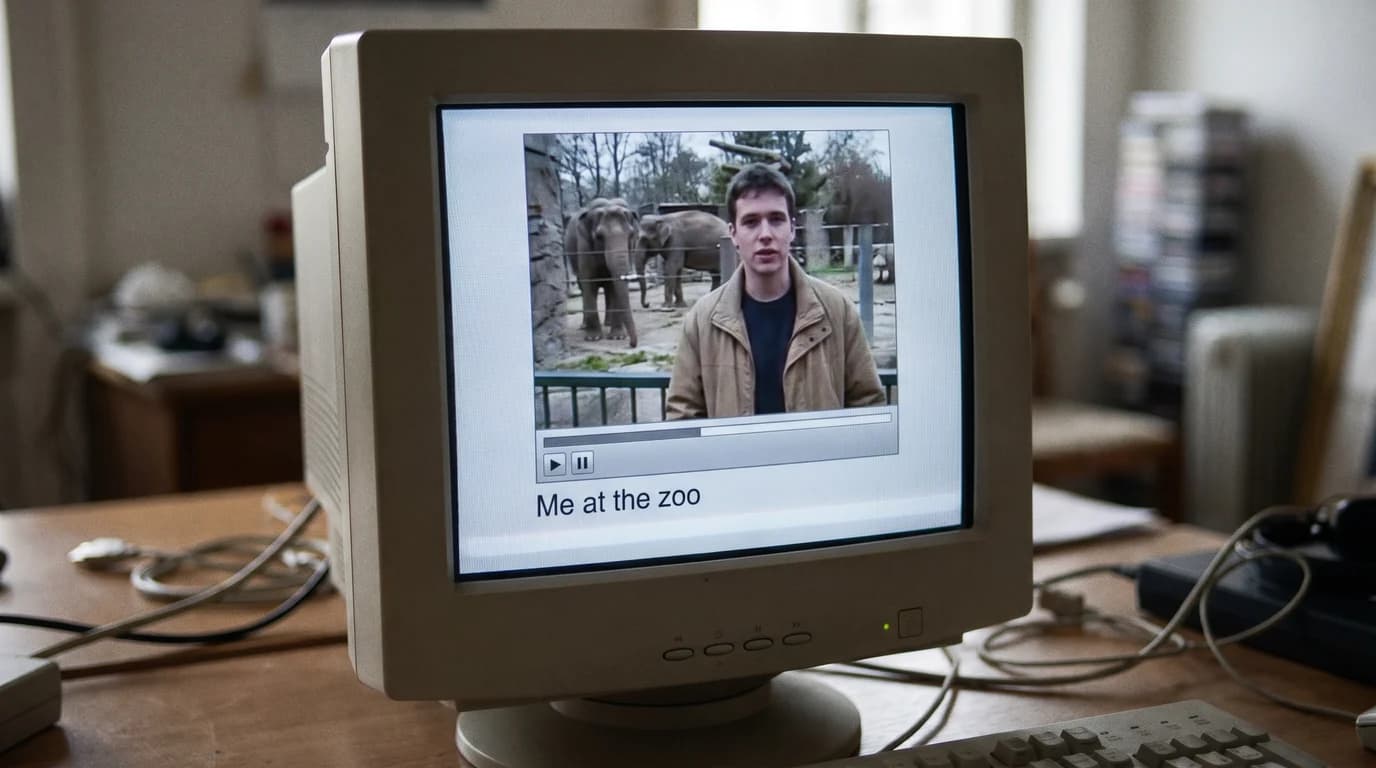
April 23, 2005. The history of the world's largest video platform began with a home video just 19 seconds long. Its title is "Me at the zoo." Jawed Karim, one of the founders, stands in front of the elephants at the San Diego Zoo and simply remarks, plainly, "The cool thing about these guys is that they have really long trunks." There is no editing, no background music, no staging. In this article, starting from YouTube's first video, we look back at the unadorned starting point of a service that changed the world, and at hints for today's creators, who so easily get tired of mass-producing short videos.
The first video was just 19 seconds of talking in front of elephants#
YouTube itself had its domain registered on February 14, 2005, and got moving as a service. And the first video uploaded was this "Me at the zoo." The content is truly trivial. That is exactly why I think the fact that this was the world's first video says a great deal.
- The starting point was a home video: It began not with professional footage or an attempt to go viral, but with an ordinary record of everyday life
- It was prompted by how inconvenient sharing was: At the time there was no easy way to share video online, and it was built to fill that gap
- It is still there today: This 19-second video remains on YouTube to this day and continues to be played hundreds of millions of times
The origin of the world's largest video culture was 19 seconds with no editing at all. For people who tense up thinking they have to make an impressive video, this is a story that quietly helps.
"I have to make it properly" is what makes it hard to keep going#
Here is the main point. In today's videos, captions, sound effects and snappy editing have become the norm, and the effort that goes into a single video keeps swelling. We hear from a great many people who burn out trying to put out a short video every day.
But what I want you to remember is the fact that the first video was 19 seconds with no editing. In fact, “letting people see who you are,” rather than elaborate editing, is often the condition for a video that gets watched for a long time. It is not unusual for plain videos made consistently to reach more people in the end than one perfect video a month. Putting in effort and keeping going are often a trade-off.
For video fatigue, deliberately cut back on the polish#
If making videos is a strain, the realistic move is to lower the quality standard on your own side. Surprisingly often, posting footage straight from the camera makes people feel closer to you.
- Allow yourself a single take: Stop assuming you will re-record and edit, and give yourself permission to publish in one take
- Cut the length short: Rather than aiming for perfection in a long video, splitting it into several short ones is psychologically easier
- Settle on a template: If you fix the structure, the burden of thinking from scratch every time disappears
You don't have to force yourself to post every day. If video feels heavy, posting less often and switching to mostly text are both perfectly respectable choices. What suits one person does not suit another.
Summary#
YouTube's first video, from April 23, 2005, was “Me at the zoo,” 19 seconds shot in front of the elephants at a zoo. There are three things to remember. First, even the world's largest video culture started out as just a home video. Second, letting people see who you are often works better than elaborate editing. Third, polish and sustainability tend to be a trade-off. If video wears you out, it is fine to lower the standard again. Shoot what you want to shoot, at your own pace.
For those of you who can shoot the video but find it quietly heavy to think up the description and the social media announcements every time: Toukoukun is a tool where you register what your work stands for once, and AI writes tailored announcement copy for each social platform. As a way to hand off the words so you can focus on making videos, feel free to take a look at the dashboard.